Building Community At America's Table

Latest

The Research Fog

written by Grant

I’m confused.

And depressed.

And so wanting to really dig into an actual meal for this One Hundred Meals project. But we need to start with some information first. We need to get informed a wee bit more neutrally before we just jump in. We need to do the homework before we arrive at the first test.

So, Ellen and I have given ourselves this task of understanding and respecting the viewpoint of big, industrial farmers. Check.

One topic comes to the fore which seems pivotal to understanding – research. We ask our new Big Ag friends, for example, what they think of the recent FDA decision to reduce antibiotic use in livestock. The response is both from the gut and experience (which we honor and respect) as well as to cite organizations and research they trust – FDA, USDA, land-grant university studies. If I’m doing my job right, I hear them out and guess what? I get that if that were the body of knowledge I had always known and was the bulk of what I’d heard for years, and I was in the business of earning a living following those principles — sure enough, I’d reach the same conclusions the Big Ag folks have reached. I would be comfortable with the current antibiotic use in animals. I would be comfortable with GMOs in our food system. So there you go – I can understand and respect Big Ag (Agvocates*) where they stand.

Turning it around, I hope they feel the same.

So are we done?

Well, if we were, contention about our food system would not exist. So, no.

Now imagine this. In my effort to internalize and understand Agvocates’ viewpoint (kinda like running a second operating system on your computer!) I read a bunch of literature and research coming from their “camp”. As I do, I am careful to note who funded the literature, what the biases are. And there are lots and lots of biases.

But here’s the thing: When I turn the mirror inward, I see, sure enough, that you find biases and questionable funding of “my” literature also.

Gridlock.

That is where my brain is right now. Stuck. Ellen, for her part, is just getting depressed.

And it gets worse: There is no arbiter for this.

You’d like for it to be the FDA and the USDA, because that is actually supposed to be their purpose for existing. But recently, if you are following along, you’ll know that the FDA is just now getting around to acting on its findings from 35 years ago. And they are only doing so because a judge forced them to. So I am hard-pressed to trust the FDA as the reliable arbiter of truth we’re looking for on these tricky questions!

Look, I do NOT come from a long history of conspiracy theory, but the more I research, the more I start to sound like such a person.

In some weird way, I am starting to distrust that a research duel will help us. I may find some research I trust. I’m not saying I can’t find that, but I am not sure pitting one body of research against another will lead us anywhere because even if the greater percentage of society or a government agency like the FDA finally chooses one body of evidence over another, does that matter? Will it lead to anything when the “other side” is still going to stay entrenched in their beliefs regardless?

If you’d like to disagree with all this gloominess, then answer one of these two simple questions:

  • If you currently disagree with antibiotic use in animals for growth purposes, whose research to the contrary would you believe? Who could turn your firmly held beliefs completely around?
  • If you currently agree with the use of antibiotics in animals for growth purposes, whose research to the contrary would you believe? Who could turn your firmly held beliefs completely around?

They’re rhetorical questions.

I will say, even being confused and depressed is better than not thinking about our food at all.

And Ellen and I are certainly thinking about things! We’re getting familiar with all the entities and interests on the Agvocate side of things. We’re learning the acronyms like GRAS, FOIA and CSPI. We’re learning how to spot influence and bias (ProTip: follow the money, which is often only barely hidden by a public service-style organization with a clever name). We’re reading the data from the Farm Bill. All in the hopes of having some solid background information before we start.

We have been busy brainstorming a starter list of Meals We Hope To Eat and we’ve posted them here for you to look over.

And we hope, soon, to sit down and eat with someone so we can get this show on the road!


*Agvocates — for the sake of clarity, from here on out, we’ll refer to Big Ag folks as Agvocates, which is what they are calling themselves these days. We’ll call the other side — the sustainable, local, Slow Food side — Agripreneurs.

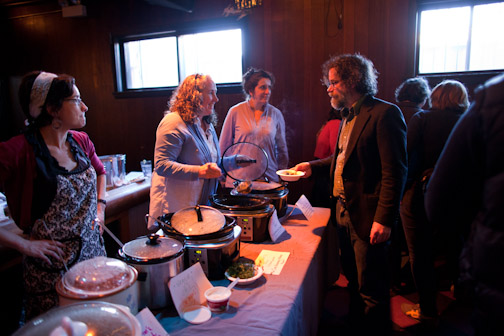
One Hundred Meals “Launch Party”

written by Ellen

OK, to be honest, we didn’t have time for an actual launch party for One Hundred Meals, so Grant and I jumped at the chance to launch the project at the season’s last Soup & Bread (and Pie!) at The Hideout in Chicago.

The founder of Soup & Bread, Martha Bayne, has built a thriving community raising money for good causes like, the Logan Square Warming Center, which was the beneficiary of last week’s event. For background, here is a good post from the New York Times (OK, really, I added that link because it is the NEW YORK TIMES WRITING ABOUT MARTHA’S CAUSE!).

Well, anyway, it was such an auspicious event, it being the last of the season, and such a good cause, building community — that it was a natural place to launch our project, designed to build community.

First Step Soup

I made what I called First Step Soup. I adapted a recipe that I got from Kristin Reese, who was at The. Breakfast. It is her family’s favorite soup and is a traditional Italian Wedding Soup that she got the recipe for from Ina Garten. Here’s what Kristin had to say about the soup:

“It as a recipe I found that tasted good and can be a meal. Meatballs can be made in advance and it is tasty. The kids like the meatballs. I used our ground chicken and add some spices to it. I love the chef Barefoot Contessa and I think this is one of her recipes…without looking. When I cook I always make little changes or ad in this or that…I bet that is how you are too. I use herbs out of my garden. Our children Campbell 4, and Parker 2, love to help cook.”

You can probably see already that learning about the lives of the people on the other side of the table can help begin to bridge gaps. The reason, of course, is that you learn to see them as people first, not just a faceless enemy force. And that was the point of this soup I was making, to use food — a tie that binds — as a gesture for building a connection.

Ellen serving First Step Soup

We thought it would be fun to add the recipe from each meal, so I made a page for that and you can go get the recipe for First Step Soup. I apologize to the “specific direction needed” folks out there but I write recipes mostly how I cook. I am sure as Grant adds recipes, they will be more organized and precise. So, there will be something for everyone over time!

It’s been a whirlwind few weeks, planning and plotting the project, reading and learning, that we haven’t really had enough time to communicate how this project is going to fall together. So, since this is the launch party post, I thought maybe it was high time to do that.

The foundation of One Hundred Meals will be a series of topics that Grant and I pursue as we set out to learn about our food supply. First up — learning how to read and understand the data and information that swirls around us, generally making us confused as we try to sort out what to believe. We’ll be announcing the first meal, whose topic is learning to research, in the next few days.

For each topic, we will be posting a preview post announcing the topic, sharing why we chose the topic and what we hope to learn, and listing a number of the questions we have about the topic. We’ll also be soliciting questions from you, so please feel free to let us know what you want to learn about each topic so we can share what we find.

Grant will be developing a photo record of the meal that we’ll share with you, and we’ll both work on follow up posts that share what we learned. We’re building a discussion board for the blog which will be incorporated into each post to try to keep the discussion strings on topic and easier to follow. We encourage you to chime in and get your voice heard on the boards.

Our target list of meals we would like to pursue will be going up shortly, as will an ever-updated reading list that includes learning and information from all sides of the issue.

Our goal is to try and sort out, really, the truth about our food supply and how regular people with busy lives and jobs can sort through the morass of conflicting information and arrive at a way of living that is in tune with their ideals.

That’s really the crux of the problem, to my mind, that it is nearly impossible to know what to choose when you don’t have ready access to real facts you can count on. And that’s what One Hundred Meals is all about — building community at America’s table while helping us — and you — understand the realities of the choices we make, instead of ignoring them or misunderstanding them.

We hope you participate, after all, we are trying to build a community here, and hope you end up getting some of your own questions answered. And, well, maybe meet a few people, like-minded and not, along the way.

Packed house at Soup & Bread!

Announcing “One Hundred Meals – Building Community At America’s Table”

written by Ellen

Recently, Grant and I had an opportunity to sit down with some “industrial farming” folks over breakfast, on the invitation of the US Farmers & Ranchers Alliance. The group, which appears to have deep ties to Big Ag, was formed to help American farmers and ranchers of all stripes and sizes connect with the American public.

It didn’t go over very well. But, if you look in the comments, it did, in fact, start a conversation.

We learned about folks who are experimenting with half GMO corn in their field this year because the corn borer just might be extra virulent this year, since winter wasn’t winter at all. You know, we get that. Really — though we still have a lot of questions about GM crops we’d like to discuss.

We started learning a bit about the finances of big meat from a former board member of the Chicago Mercantile Exchange. We might not agree with him — OK, we don’t agree with him — but we started feeling the need to at least understand him.

We got challenged about feeding the poor. It seems no one has any good answer about that, to be honest, but it does loom large over all our heads as the world’s exponential population growth makes the magnitudes of future peoples who will need food nothing short of staggering.

We launched discussions with an industrial dairy man about why we can’t get raw milk and while he talked a lot about safety, we talked a lot about how the dairy idea of safety and our idea of safety are two different things. And we want to know where we can turn to, maybe, get our voice heard.

And we learned that industrial farmers are often terrorized in their homes by “well-meaning” foodies who commit violence, vandalism and other hate crimes in the name of saving the food supply. Scary but true.

In other words, we started learning what the other side is thinking — and that they were, in fact, thinking — and we realized that what seems to be missing in the food dialogue is active conversation with people who don’t agree with each other.

We’re not talking about groups of people setting out to educate the other side. We definitely are not talking about getting the propaganda right. We’re talking about actual dialogue. The kind that sparks new ideas, broader thinking and maybe even builds some new communities.

Because in a world where one Obama is greenlighting GMOs while the other is promoting a family garden, we believe it might be time for all of us to take a step back and learn. Time to unravel the crazy contradictions, to wade through the misinformation and disinformation and get to the bottom of the hypocrisies we all have about our food supply.

Our goal is to at least understand where our food supply went off the rails and how we are supposed to live — and make good decisions about what we eat — within the bubbling mess.

After all, it can become a little difficult to make the right decisions when the answers to just about all the questions are murky and complicated. Heck, we’d venture that even the questions are essentially murky and complicated.

So, we decided to start a project.

The idea is pretty simple: start sorting out the questions, meet with the people in our food community that can give us some answers, experience first hand the realities of food, and build a platform for people on all sides of the conversation to come together and discuss those questions and answers.

To, really, bridge the divide and build community through One Hundred Meals.

Here’s the rundown:

  • We’re gonna eat One Hundred Meals with people who are involved in our food supply. We want to eat with GMO advocates, urban foragers working with the homeless, farmers of all stripes, policy makers, and even some regular folks.
  • Each one of those meals is designed to get us out of our comfort zone and into a learning zone — helping us stand up and face parts of our food supply we don’t want to think about but should probably know about.
  • We’ll share photos and stories from the meal, inviting all participants to weigh in and present their ideas and thoughts so that everyone has an equal opportunity to say what is on their mind.
  • We don’t know how long it will take. We have a website to build, funds to raise, plans to make and a lot of learning to do. And, since this is just a project and not our jobs, we likely won’t be racing through the meals one after another, either.
  • Our goal is to open up productive discussion. On the website, we are planning an extensive discussion platform and we’ll invite all to participate. But, we’ll also work to keep the conversation civil — so we hope you’ll join in but we also need you to add to the discussion, not just drag it down.
  • We’ll share an extensive reading list from all sides, helping our readers learn about topics holistically, instead of just from their own vantage point — an opportunity sorely missed in most everyday discourse.
  • Although we definitely have opinions, our goal for the site is to try to approach each topic as neutrally as possible and with as much humility as possible. We invite you to tell us if we veer off course.
  • We’d like to be a platform for building a community of food that helps everyone learn, grow, and hopefully, eat.

As I wrote on Backyarditarian.com, we both, Grant and I, would like to explore our food shed, for a time, in the spirit of the Nash Equilibrium — an expression of game theory where, in order to win, each person in food needs to make choices that contribute to everyone’s welfare.

After all, food is not a zero sum game. We either all win or, frankly, we are all going to lose.

_________________________________

To read the blog post from Ellen that started it all: Just Because the Canary Is Alive…

To read more about Grant’s food learning curve: MyFoodshed